
OnlyFans Price Floors and Minimum Subscription Entry
OnlyFans paid subscriptions begin at a hard floor of $4.99, and that single number shapes almost every pricing decision on the platform. If you have ever wondered why so many pages sit at exactly $4.99 or $5, the floor is the reason. This guide explains how the minimum works, where promotional discounts fit, and how to read price signals before you spend. BestOnlyFans refreshes its rankings every month.
Paid pages must price their base subscription somewhere between $4.99 and $49.99. Most creators cluster in the $5 to $10 band because that range converts best with casual subscribers. Anything advertised below $4.99 for ongoing access is either a first-month promotion or a signal worth examining closely.

How OnlyFans Price Floors Work
The floor exists because the platform needs a viable revenue baseline for creators. After the 20% platform fee, a $4.99 subscription leaves the creator roughly $3.99. Below that level, the economics stop working once you account for payment processing, chargeback exposure, and the time required to produce content.
Before any page can charge for access, it has to clear a set of eligibility checks. These are not optional, and missing any one of them keeps the page in free mode.
- Verification completion: government ID and a live selfie match must clear review.
- Payment setup: a valid payout method tied to the creator’s legal identity.
- Content minimums: enough published posts that a subscriber sees value on arrival.
- Price floor compliance: the base rate sits at $4.99 or higher, never lower.
A card verification hold of $0.10 is common when a payment method is first attached. That charge is refunded within days and is not part of the subscription price. It is an anti-fraud check, not a fee.

| Price Category | Minimum Allowed | Typical Range |
|---|---|---|
| Promotional first month | Can dip below $4.99 | $3 for the first month, then base rate |
| Standard paid subscription | $4.99 | $4.99 to $15, averaging $5 to $10 |
| Free page base access | $0 | $0, monetized through PPV and tips |
| PPV message unlock | Set per message | Up to $50 per unlock |
Promotional Pricing Within Platform Limits
Discounts below $4.99 are allowed only as promotions, and only for the first month. A creator can set a $3 opening month to lower the barrier for new subscribers. That price does not extend, and it does not reset the base rate.
The conversion path is predictable once you know the sequence. Understanding it prevents surprise charges at renewal.
- The creator sets a promotional rate for new subscribers.
- The platform approves the discount depth within allowed limits.
- The subscriber is charged the reduced first-month amount.
- Access continues at the standard base price after the promotion ends.
- Auto-renew adjusts to the base rate, or stops if the price was raised.
One detail matters more than the rest: when a creator raises the base price, auto-renew stops for existing subscribers. Their access lasts until the paid period they already bought runs out. Nobody gets silently charged a higher renewal without the renewal itself being re-authorized.
Tip: screenshot the renewal terms page before subscribing to a promotional offer. The displayed first-month price and the stated renewal price are two different numbers, and only the second one repeats.

Reading Price Signals on Ranking Cards
The platform has no built-in discovery feed or directory. That structural gap is why ranking and comparison sites exist in the first place, and why the data they display matters. A ranking card that tracks price history tells you whether today’s number is a promotion or the real base rate.
In our methodology, BestOnlyFans records price changes over time rather than only displaying the current figure. A single snapshot cannot distinguish a temporary discount from a permanent cut, so the history is the useful part.
Six data points make a pricing history readable at a glance:
- Current price: what a new subscriber pays today.
- Previous price: the last recorded base rate.
- Direction: whether the change moved up or down.
- Magnitude: how large the change was in absolute terms.
- Time since change: how recently the number moved.
- Promotional flag: whether the current rate is a first-month offer.
A page holding $9.99 for eight months reads very differently from one that has bounced between $4.99 and $19.99 four times. Stability usually indicates a creator who has settled on a working price. Volatility often indicates testing, or something less healthy.

Free Pages and the Zero-Dollar Alternative
Free pages set their base price to $0 and earn through other mechanisms entirely. There is no subscription charge, so the revenue comes from pay-per-view messages and tips instead. This model suits creators who prefer volume over committed subscribers.
On a free page, PPV messages unlock at a set price, capped at $50 per unlock. Tips can reach $100 and are entirely voluntary. Paid chat commonly runs $3 to $5 per message, which adds up quickly for subscribers who use it regularly.
The zero-dollar model changes the risk profile. You never face a renewal charge, but you also never get the bundled access a paid subscription provides. Every piece of content has its own price, and spending is entirely driven by your own choices in the moment.

Detecting Pricing Anomalies
Most pricing you encounter will be ordinary. The exceptions are worth recognizing before money changes hands, because unusual patterns sometimes precede account problems. Non-standard pricing can also point to imitation pages built to harvest card details, which is why comparison work at the best only fans usa level includes a price-history check rather than a single snapshot.
Five red flags in pricing data suggest irregularities worth pausing over:
- Sub-$4.99 ongoing pricing: a base rate below the floor after the first month.
- Frequent oscillations: the price swinging repeatedly within short windows.
- Mid-cycle changes: an unexplained charge appearing inside a paid period.
- Mismatched conversions: currency figures that do not align with the stated rate.
- Missing history: no record of prior pricing anywhere the page appears.
Anyone can learn to recognize phishing attempts, and applying that skill here is reasonable. A page demanding payment outside the platform’s own checkout has already broken the normal flow, regardless of what price it displays. Card details entered anywhere else are exposed to fraud and identity theft risks the platform’s own billing never creates.

Planning Around Price Floor Mechanics
Budgeting around a price floor is mostly about sequencing. The floor sets the minimum, promotions lower the entry point temporarily, and renewals return to base. Plan for the base rate, not the promotional rate, and the numbers stay predictable.
Four strategies keep spending aligned with what you actually intended:
- Promotional trial sequencing: use first-month offers to test pages before committing.
- Renewal date staggering: avoid clustering multiple renewals in the same week.
- Free-to-paid transition planning: decide in advance whether a free page is worth converting.
- PPV cost mapping: estimate unlock spending separately from subscription spending.
Treating subscriptions as a fixed line item rather than an open tab is the difference between a controlled hobby and a monthly surprise. A simple written budget takes ten minutes and removes the guesswork entirely.
If you want a practical benchmark, list every active subscription, its base rate, and its renewal date in one column. The total is your real monthly commitment. Promotional pricing distorts that list only until the first renewal, after which the base rates are what you are actually paying.
Platform Fee Impact on Effective Costs
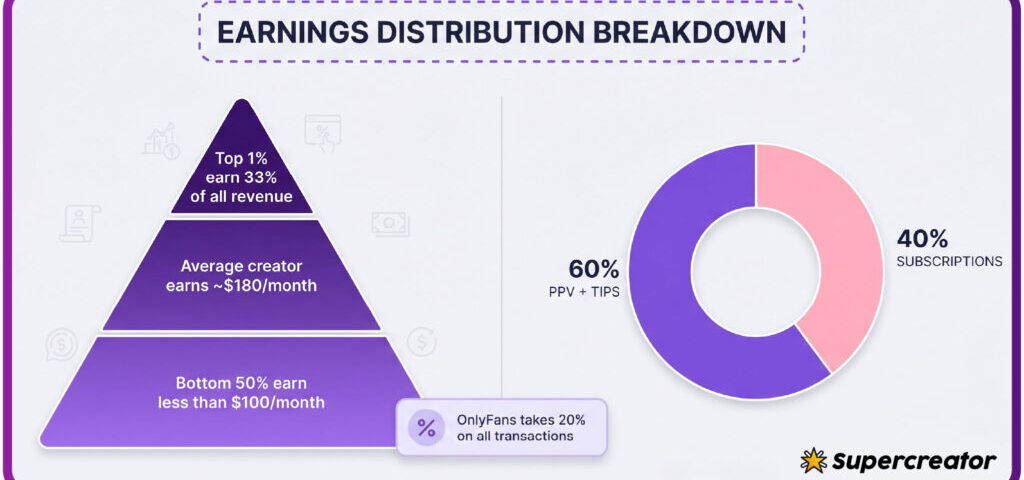
The 20% platform fee applies to everything: subscriptions, PPV unlocks, and tips. Creators keep 80%. This does not change what you pay, but it explains why the floor exists and why some creators push toward the upper end of the range.
| Subscriber Pays | Creator Receives | Platform Fee |
|---|---|---|
| $4.99 | $3.99 | $1.00 |
| $9.99 | $7.99 | $2.00 |
| $14.99 | $11.99 | $3.00 |
At the floor, the creator’s share is under four dollars per subscriber per month. That figure makes the $4.99 minimum look less like an arbitrary rule and more like a survival threshold. For subscribers, it means the cheapest paid tier still represents meaningful value transfer rather than a throwaway amount.
Understanding the split also clarifies why creators mix revenue streams. A $9.99 subscription and a $5 message unlock generate similar creator revenue after fees, but they carry different effort and risk. A BestOnlyFans ranking card that lists both figures gives you a fuller picture of where your money is going before you commit.
FAQ
Why does OnlyFans enforce a $4.99 minimum for paid subscriptions?
The floor keeps creator economics viable after the 20% platform fee and payment costs. Below $4.99, the creator’s share drops under four dollars per subscriber, which does not cover the work involved in maintaining a paid page.
Can creators ever charge less than $4.99 for ongoing access?
No. Only first-month promotions may dip below the floor, such as a $3 opening month. Ongoing base pricing stays at $4.99 or higher, between the minimum and the $49.99 maximum.
How long do promotional first-month discounts typically last?
They apply to the first billing period only. Once that period ends, the subscription renews at the creator’s standard base rate, and auto-renew adjusts to the new figure automatically.
What happens to my subscription when a promotional rate expires?
Your access continues and the renewal charges the base rate. If the creator raised the base price during your promotional period, auto-renew stops and your existing access lasts until the paid period you already bought ends.